
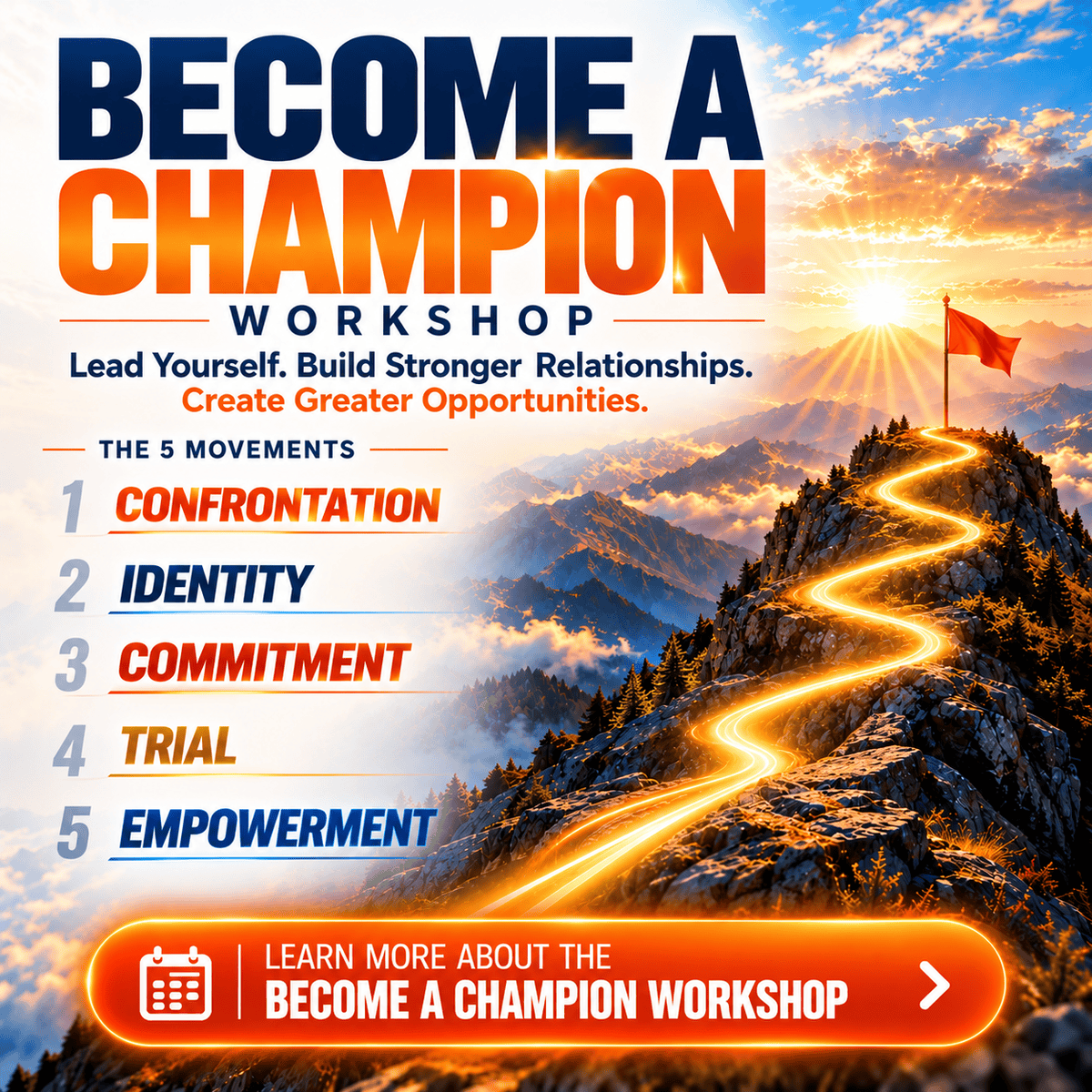
Every business owner is settling somewhere, and it shows up in their relationships long before it shows up in their revenue. The Become a Champion Workshop is built to confront that, define who you’re becoming, and send you out equipped to lead yourself first.
Become a Champion Workshop — Third (3rd) Wednesday of each month from 2–3 PM ET
Five Movements to Become a Champion: Confrontation, Identity, Commitment, Trial, and Empowerment. Leave equipped to lead yourself first, because that’s what drives better relationships, better outcomes, and real momentum. Open to members and visitors.
🎯SIGN ME UP
The Problem Nobody Puts on the Agenda
Most business owners spend their energy on the outside: more leads, a sharper pitch, a bigger network. Those are fine goals. But every relationship you have, with a client, a referral partner, a future Champion, is a reflection of how well you’re leading yourself. If that part is off, the rest never quite works.
You probably already know where. The places we settle are rarely hidden from us. It’s the follow-up we keep postponing, the introduction we never made, the standard we quietly lowered because nobody noticed. It’s the gap between who we’re showing up as and who we know we’re capable of being.
Ask yourself one question: do you feel capable of more than you’re currently showing up as? If the answer is yes, that isn’t a flaw. It’s the reason this workshop exists.
Most networking advice starts with other people: who to meet, what to say, how to follow up. The Become a Champion Workshop starts with you, because that’s what makes you someone worth building a relationship with. Lead yourself first, and your relationships, your referrals, and your results change with it.
What Happens in the Workshop
The Become a Champion Workshop is a live session that takes business owners through the Five Movements to Become a Champion: Confrontation, Identity, Commitment, Trial, and Empowerment. The goal is simple: leave equipped to lead yourself first, because that’s what leads to better relationships and better outcomes. The standard is three words: Discipline. Action. Momentum.
It isn’t theory, and it isn’t a lecture. Three things make it different:
- Every movement ends with something you do this week. You don’t leave with notes. You leave with a specific action tied to a real relationship in your business.
- You hear from someone who already did it. Before the movements are taught, a Champion from inside H7 is interviewed live, in conversation rather than a prepared speech. It’s proof the movements work for someone you can see yourself in.
- You say it out loud. Commitments get spoken to the room, because a commitment you haven’t said out loud is just a preference.
The whole session runs on ChampionOS™, the operating system behind how H7 builds relationships. That’s what makes the work repeatable instead of a one-time burst of motivation.
Here is each movement, and what it asks of you.
WHAT IS A CHAMPION?
A Champion isn’t defined by titles or income.
A Champion:
🚩Shows up consistently
🚩Leads with intention
🚩Builds real relationships
🚩Executes when others hesitate
At H7, we build Champions—on purpose.
Movement 1: Confrontation
Face the truth about where you’ve been settling.
Champions don’t avoid the hard conversation with themselves. Confrontation means being here, being clear, and being kind, with yourself first and then with others. It isn’t conflict. It’s naming what’s true without softening it into something comfortable, because you can’t lead people through a truth you haven’t faced yourself.
It shows up fast in relationships. Someone offers an introduction and it never happens. A relationship that used to have a rhythm goes quiet. The instinct is to let it fade. Confrontation is the alternative: follow up within five business days to re-anchor the ask, or name the drift directly with “I noticed it’s been a while. What happened?” Done early and kindly, it keeps a relationship honest before resentment builds.
Watch for the signs: communication has stopped, opportunities are no longer being discussed, follow-up commitments aren’t happening, visibility has dropped, or there’s been little engagement over several months.
My own turning point was a confrontation. After nearly 2,500 one-to-ones, I finally admitted I’d been sabotaging myself by never asking for introductions for myself. The truth had been sitting in front of me. I just hadn’t named it.
This week: name one follow-through gap or cadence drift you’ve been avoiding, and decide how you’ll address it.
Movement 2: Identity
Start with the truth everything else rests on: you are enough. Full stop. If you can’t settle that internally, you’ll always be performing instead of leading.
Then comes the part most people get wrong at first. Asked to describe themselves in three words, they reach for traits: reliable, strategic, driven. That’s not it. Your three words aren’t about you. They’re about what happens to the person who hires you.
They don’t have to be three separate traits, either. They can be one compact phrase that names the transformation someone gets from working with you. Mine is “Become a Champion.” That’s literally the promise: hire me, and this is what happens to you. This workshop carries the same name for the same reason.
Get those words right, then build to one clear sentence: what you do, and who it’s for. Write it so someone who has never met you can understand it.
Here’s why it matters in a relationship. Your three words are exactly what someone else would say when describing what it’s like to work with you and what you deliver. That’s what they need to introduce you or refer you with confidence. A vague identity means people can’t act on your behalf, no matter how much they like you.
The standard you set for yourself is the standard everyone around you will eventually rise or fall to. Set it on purpose.
This week: write your three words and the one sentence they build into.
Movement 3: Commitment
Choose the leader you’re committed to becoming.
Commitment starts with yourself, not with a promise to change your behavior for someone else’s benefit. Self first, others second. Not because it’s selfish, but because you can’t pour from an empty tank. Put your own mask on first.
Commitment means embracing the responsibility that comes with the identity you just claimed, not just agreeing with it. And a commitment you haven’t said out loud is just a preference.
The test is a single sentence: “I’m committed to becoming a leader who ___.” A decision has no escape clause. You don’t say “I’ll try to” or “I hope to.” You say it, and it’s done. Others have finished that sentence with “follows through, even when it’s inconvenient,” “confronts the truth instead of avoiding it,” and “shows up consistently for the people who show up for me.”
Then check what you wrote. Is it a decision, a specific behavior? Or does it still sound like a wish, a trait?
I learned what a real decision feels like in 2020. When the pandemic shut down every in-person H7 meeting, I decided within two days to move H7 online. I still had to learn Zoom. The decision came first and the skills followed.
This is also where a Connection becomes a Bridge. When you commit to yourself first, your follow-through with someone else stops feeling like an obligation and starts feeling like a decision, and people can tell the difference.
This week: finish the sentence, say it out loud, and make sure it describes a behavior.
Movement 3: Commitment
Choose the leader you’re committed to becoming.
Put your own mask on first. You can’t commit to leading others until you’ve committed to your own growth.
That’s why Commitment follows Identity. You just claimed who you are. Commitment means embracing the responsibility that comes with that identity, not just agreeing with it. Agreeing is easy. Responsibility is what you do when it’s inconvenient.
Be specific about the leader you’re choosing to become. Maybe it’s a leader who follows through, even when it’s inconvenient. Maybe it’s one who confronts the truth instead of avoiding it. Whatever yours is, say it out loud. A commitment you haven’t said out loud is just a preference.
I learned what that looks like in 2020. When the pandemic shut down every in-person H7 meeting, I made up my mind, through prayer and meditation, to be intentional: to come at life instead of letting life come at me. That was a commitment to myself, and it shaped every decision I made for H7 through that period. Five days before lockdown, I had decided to move the whole business online. I still had to learn Zoom.
This is also where a Connection becomes a Bridge. When you commit to yourself first, your follow-through with someone else stops feeling like an obligation and starts feeling like a real decision, and people can tell the difference.
This week: name the leader you’re committed to becoming, and say it out loud to someone.
Movement 4: Trial
Put your commitment into action through challenge and experience.
Action without measurement is just motion. Track what you’re doing so you can prove it’s working.
Don’t chase mass appeal. You need a small circle who would show up for you no matter what. Think: who’s in your foxhole? The trial reveals your real peer group, the people who would stand with you, not just the ones who show up when it’s convenient.
The workshop gives you a way to measure it. It’s the Relationship Ladder, and it’s a measurement, not a feeling:
| Stage | What it means | Rhythm |
|---|---|---|
| Contact | You’ve met in passing; a one-to-one hasn’t happened yet | — |
| Connection | You’ve completed a one-to-one and it went well | Every 6 months once trust is established |
| Referral Partner | Shares your target market, but something is keeping the relationship from becoming a Champion Relationship | Every 3–6 months |
| Champion | Shares your target market and your decision-maker, so you’re both ultimately talking to the same person | Every 4–6 weeks |
A Connection who shares your target market moves into the four phases of ChampionOS™ instead, which determine whether the relationship progresses toward Referral Partner or Champion. And at Referral Partner, part of the work is naming what that “something” actually is.
This is where you earn confidence. Proof, not promises, is what moves someone from a contact to a Champion. Results are what earn the right to be referred, vouched for, and included in someone’s circle.
This week: tag where your key relationships actually sit on the ladder, and for anyone stuck at Referral Partner, name what’s keeping them from Champion.
Movement 5: Empowerment
Leave equipped to lead with Discipline. Action. Momentum.
You weren’t given information. You were equipped, and there’s a difference.
Confidence without discipline fades in a week. Discipline is what turns the work into momentum. Leading with Discipline, Action, and Momentum means the next seven days matter more than the workshop did.
This is how you actually Become Champions with people: not just informed, but equipped to keep opening doors, building bridges, and earning confidence with the next person. It’s the mission in motion, opening doors and creating more opportunities than any of us reach alone.
That’s why this movement hands you a toolkit for staying connected, and none of it requires a meeting. Small, consistent touchpoints turn the work you did into real momentum. Each one activates one of the four phases of ChampionOS™ in miniature:
| ChampionOS™ phase | Your touchpoint | What it sounds like |
|---|---|---|
| Open the Door | Reach out after a win | “Congratulations on the promotion.” |
| Build the Bridge | Check in | “What are you focused on right now?” |
| Earn Confidence | Share a resource or make an introduction | Ask yourself: “Who should this person know?” |
| Become Champions | Celebrate milestones | Anniversaries, birthdays, awards, company growth |
The rhythm stays the same as the ladder: every 6 months for Connections, every 3–6 months for Referral Partners, every 4–6 weeks for Champions. Discipline is choosing a touchpoint before you leave the room, not waiting until the relationship needs attention again.
This week: pick one touchpoint and use it before the week is out.
What You Leave With
- Clarity. Your three words and the one sentence that makes you easy to refer.
- A commitment. A decision about the leader you’re becoming, said out loud.
- A way to measure. The Relationship Ladder, so you can see where each relationship actually sits and what rhythm it needs.
- A seven-day plan. A touchpoint chosen before you leave the room, because the next seven days matter more than the workshop did.
That’s Discipline. Action. Momentum. Not inspiration that fades by Monday, but a plan that starts the next day.
Join us live
- Become a Champion Workshop: Third (3rd) Wednesday of each month from 2–3 PM ET
- Open to visitors and members of H7 Network
- RSVP: Reserve your spot
If you want to keep going after the workshop, the path is clear: Join H7, then take the Connect, Serve, and Ask® Course to learn how it works, onboarding to get activated and matched with your group, and then the FUEL rhythm with the rest of us.
Champions aren’t born. They’re built.

Clay Hicks
Founder & CEO, H7 Network
After 10,000 recorded one-to-one conversations, I built Connect, Serve, and Ask® — the relationship methodology behind ChampionOS™. My purpose is simple: lift others up, unite them, and take no credit for their success.
👉 Find a group near you and see it in action.